
The era of muscle cars is long gone, where everything from engine control to drifting relied upon manual operation. Nowadays, every push of the accelerator and brake pedal is monitored by a black box positioned behind the driver. This electronic application has brought about a turning point in history, as cars can now be produced that have never been faster, more stable, and better controlled for any driving style or purpose.
It also matters far beyond the enthusiast world. NHTSA estimates that 39,345 people died in U.S. motor vehicle traffic crashes in 2024, or 1.20 fatalities per 100 million vehicle miles punched in, down from 1.26 the previous year. At the rational level, every 10% cut in vehicle weight is an average cut in fuel consumption by 6%–8%, which attests to how performance, safety, and efficiency have become mistakenly wedded into the same electronic and engineering improvements.
What Automotive Embedded Systems Actually Do
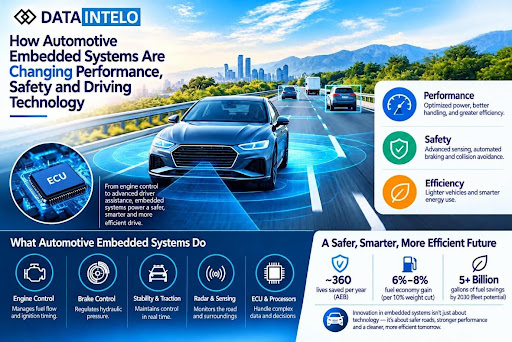
An embedded system is a specialized computer that is embedded in a vehicle to perform a specific function in real time. Engine control units control the fuel flow and the spark; the controllers control the electric torque and the brakes control the pressure, and the radar systems watch the road ahead of the vehicle. If traction control fails at a speed of 62 mph, it is useless. Therefore, all embedded systems are designed to work flawlessly without a single failure.
This is why the investments in the sector are so high. According to research by Dataintelo, the global market of automotive embedded system was valued at nearly USD 91 billion in 2025 and is projected to reach USD 161.9 billion in 2034, registering a CAGR of approximately 7.4% between 2026 and 2034. That implies roughly USD 70.9 billion of added value across nine years. For enthusiasts, the message is plain: the next generation of performance cars will be tuned in software as much as in the machine shop.
Performance: Where Code Meets Horsepower
Powertrain controllers constantly adjust fuel supply, ignition timing, boost, and transmission shifts. Meanwhile, traction and stability systems control the production of torque and help slow down the wheels, enabling rear-wheel-drive muscle cars to stay on the road. Electric powertrains take this a step further by utilizing inverter and battery control software in order to ensure that torque is produced as soon the driver presses the gas pedal.
Weight is the other half of the equation, and the data here is strong. According to the U.S. Department of Energy, a reduction of 10% in the weight of vehicles can lead to an improvement of fuel economy of between 6%–8%. Lightweight materials are able to achieve 50% reduction of the weight of the vehicle body and chassis. By replacing the heavy steel components with high-strength steel, aluminium, and glass-fiber reinforced polymer composites, the weight of the components can be reduced by 10%–60%. The lighter vehicle accelerates quicker, stops shorter, and performs turns in a better way.
Trucks and Fleets: Efficiency at Scale
Embedded technology is essential for commercial vehicles. For example, many trucks depend on engine controllers for load-dependent fueling, electronic stability control for getting heavy things going in tow, or telematics for the management of entire fleets. Small improvements in efficiency accumulate very fast over hundreds of vehicles and millions of miles traveled. Pickups and vans with a total weight of less than 10,000 lb fall under the same AEB rule as cars, which means that a work truck with a shipping cargo must meet the same requirement of stopping and avoiding the obstacle at a speed of 62 mph as a small car does. DOE puts things straight. By its estimates, if advanced materials allow to use lighter components and highly efficient engines in one-fourth of the American vehicle fleet, it could save over 5 billion gallons of fuel annually by 2030.
Safety: The Technology That Works When Drivers Cannot
Performance is where it grabs the eye but it is safety that makes embedded systems useful. Automatic emergency brakes, a forward collision warning, and pedestrian detection gauge risk based on radar and camera data, thus activating brakes before the driver applies pressure to the pedal. The NHTSA has established Federal Motor Vehicle Safety Standard No. 127, which is applicable to all vehicles, such as passenger cars and light trucks. The main points of the requirement are the following:
- The requirement for new passenger cars and light trucks with a weight of no greater than 10,000 lb will be effective starting September, 2029.
- The collision mitigation system must be able stop the vehicle before hitting another car in front, at the speed of up to 62 mph.
- The automatic brakes must be activated at the speed of up to 90 mph in case of a lead-vehicle crash.
- The vehicle must be equipped with automatic brakes that apply the brakes when it detects pedestrians traveling at a speed of up to 45 mph, both during the day and at night.
- The National Highway Traffic Safety Administration estimates that this will save 360 lives and avoid more than 24,000 injuries.
Meeting these thresholds requires the use of sensors, processors and software that works accurately in rain, glare and darkness and crashes safely when things go wrong.
The Government Numbers at a Glance
The table below summarizes the official figures used in this article.
| Metric | Figure | Source |
|---|---|---|
| U.S. traffic deaths, 2024 (estimate) | 39,345 | NHTSA |
| Fatality rate, 2024 | 1.20 per 100M VMT | NHTSA |
| AEB stop-and-avoid speed | Up to 62 mph | NHTSA |
| AEB lives saved per year | At least 360 | NHTSA |
| Fuel economy gain per 10% weight cut | 6%–8% | DOE |
| Fleet fuel savings potential by 2030 | Over 5 billion gallons | DOE |
Is the Safety Trend Moving the Right Way?
The early numbers are encouraging. According to the National Highway Traffic Safety Administration (NHTSA), in the first three quarters of 2024, about 29,135 individuals were killed in road accidents, whereas the figure was 30,490 during the same period of 2023. The rate of deaths also fell from 1.24 to 1.18 per 100 million vehicle miles travelled. In fact, fatalities dropped in an estimated 35 states nationwide as well as Puerto Rico, marking the 11th consecutive quarter for fatalities to go down. In general, the first estimates for the first quarter of 2025 suggest that there may be 8,055 deaths, thus 6.3% lower than the 8,595 deaths expected in January-March 2024.
There wasn’t any specific technology that played a crucial role in successful road safety for the whole year. In addition to technologies, road safety enforcement also matters, as well as road design and driving behavior. In this regard, however, it should be noted that even NHTSA puts emphasis on various factors, such as speeding, impairment, distraction while driving or seatbelt use as a priority in road safety.
Changing How We Drive
Ownership of software is undergoing transformations. With the help of adaptive cruise control, lane-keeping assistance, driver-monitoring systems, digital instrument cluster, and remote updates, automobiles are capable of self-improvements after leaving the dealership. An update can adjust throttle response, change brake feels, and close the loophole without going to a repair shop. For tuners, the question appears of where the factory software ends, and the personal modification process starts.
The issue of intervention systems is a worry for some drivers, who believe that this technology removes the connection between the driver and the road. The best systems do not interfere with hard driving and work only when a crash is inevitable.
What to Watch Next
Tracking a handful of developments is worthwhile in the coming years:
- The purpose of the September 2029 AEB deadline is to make automatic braking an integral part of the light-vehicle fleet.
- The expected market growth to USD 161.9 billion until 2034 indicates that suppliers will continue investing in processors, sensors, and software.
- The implementation of lightweight designs will promote a 10% drop in vehicle weight, providing 6%–8% efficiency gains in the market.
- Increased coordination between performance control systems and safety systems means that the systems of traction, stability, and braking will work as one.
The Bottom Line
Automotive embedded systems are responsible for launching a vehicle, towing a vehicle and fuel efficiency that a vehicle achieves, apart from looking after the safety of passengers inside and outside the vehicle. AEB compliance is expected to avert road accidents leading to 39,345 fatalities in the U.S. in 2024, while removing just 10% of the weight of a vehicle results in a 6-8% increase in fuel efficiency and the market valued at USD 161.9 billion by 2034 means the trend is clear. Exciting cars will effectively combine great mechanical solutions with software that is reliable and honest about its capabilities. Now performance and safety are not competing concepts for people who love driving.





Comments